
Unlearning Empire-Based Thinking
"I'm sick of feelin' impotent watchin' the world burn/In the era of apocalypse, waitin' my turn"

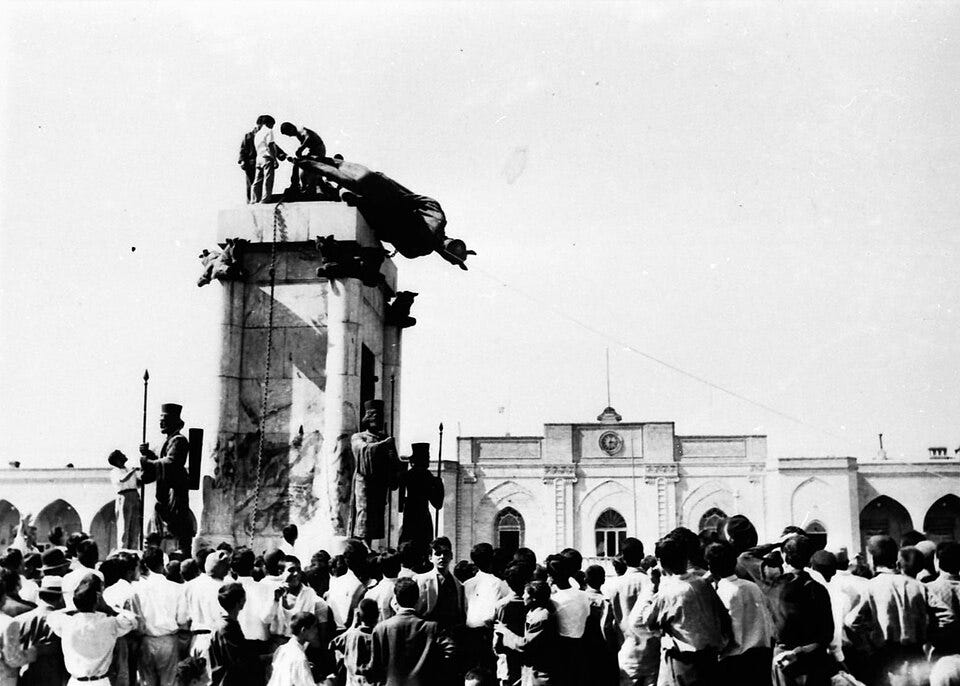
A nation in the crosshairs of empire faces an impossible decision. Align with Western power and lose sovereignty, or resist it and risk economic suffocation and war. Like Iran, one third of the planet is under United States sanctions, responsible for 38 million deaths in the last 50 years. That’s an insane fucking number. A slow, silent (to the west) genocide to accompany all of the loud and fast ones that Genocide Joe and his predecessors have so proudly notched under their belts.
For a long time I didn’t speak about Iran because sometimes its better to just shut the fuck up than speak out of turn, but hey, here we are. In my last piece I addressed the very real organic uprising of the Iranian people to demand their own freedom and self-determination, yet in doing so I fear that my language suggested a moral equivalency between the Islamic Republic and the U.S. of Israel, which just isn’t anywhere near possible. I saw a comment clowning me for quoting the Bhagavad Gita when I referenced the U.S. as the “destroyer of worlds,” a passage popularized by Oppenheimer. Okay, I admit, I saw it in the movie, but it’s really what I meant!
A conversation of nuance is incomplete without consideration of the imbalance of power. The U.S. is the nation of the atomic bomb, chattel slavery and Native American genocide. We take the cake for human rights abuses and it’s not even close. As the primary architect of many of Iran’s problems, America has no right to feign any fucking moral superiority as well as absolutely no right to attack Iran, and Iran, like any nation under threat, has the right to defend itself. No matter the behavior of the Islamic Republic, it is pivotal to understand the difference between internal political struggle and foreign invasion. The only people with authority to upend the Iranian government are Iranians themselves.
A friend really made this make sense to me with an analogy to the “Black-on-Black crime” argument. People protest police violence, and someone immediately says, “But what about Black on Black crime?” As if that somehow justifies the police killing people, or makes state violence any more legitimate. I regret partially falling into that trap in this conversation, but if there’s one thing I’m committed to, it’s constantly learning. And once you learn that it was the CIA who overthrew Iran’s democratically elected Prime Minister, Mohammad Mossadegh, in 1953 after he nationalized the country’s oil program and took back control from Britain, the pretense of humanitarian intervention becomes more hypocritical than ever. (This really happened, by the way. Look up Operation Ajax).
What we are watching are the direct after effects of the US government autonomously deciding that preserving their interests was more important than the will of the Iranian people; you can’t then turn around and claim you are raining bombs on a country on behalf of those very same people. The very same people, by the way, who have a 95% literacy rate, amazing film and university programs, and many women in civil service. Like the real world, it is far from a utopia, but it’s also a far cry from the desolate regressive wasteland that America wants you to believe it is, too.
In fact, for all of the stigma around modern Iran, the country has never initiated a war or expansion against a neighboring country. Only the United States has a military budget bigger than the next dozen countries combined, which is why watching the U.S. posture like a reluctant hero in this moment as the Trump admin continues to erode our civil rights is peak absurdity. America has helped create a geopolitical disaster after spending decades intervening in Iran’s politics, and is now presenting bombs as the solution. People point out U.S. imperial aggression, and suddenly the response pivots to “But what about Iran’s human rights abuses?” Both conversations can exist, but they are not the same conversation, especially when the U.S. has a long history of destabilizing governments that refuse to align with its interests.
The people of Iran shouldn’t be martyred for Washington’s regime-change fantasies nor for Israel’s regional strategy. The US helped install the conditions that produced the current government, couldn’t control it, sanctioned the population into economic crisis, and now want to sell military escalation as “stability.” I’m not in anybody’s camp, but I am on the side of human dignity, and that starts with letting the 90 million people of Iran fight for the future they want without American interference.
Learning is a process that I don’t do in isolation; it requires constant conversations with those who know much more than me. Writer and journalist Kamin Mohammadi was kind enough to offer her own insights as to how we should push back against this harmful narrative of Iranian life and reject stigmatized media narratives of what Iran needs, especially with respect to American interference. Please take the time to read some of her insights below in an edited transcript from that conversation.
